Quantum Computing Explained: Qubits, Superposition and Why It Is Not Just a Faster Computer
Ordinary computers use bits that are 0 or 1. Quantum computers use qubits that can hold both possibilities at once, and that changes which problems they can solve.
A school computer lab, a smartphone and a giant data centre all work on the same basic principle: information is stored in bits, tiny switches that are either 0 or 1. Everything on your screen, from a cricket score to a film, is built from enormous numbers of these switches. Quantum computers use a different building block, and that is why they are exciting, and often misunderstood.
The qubit
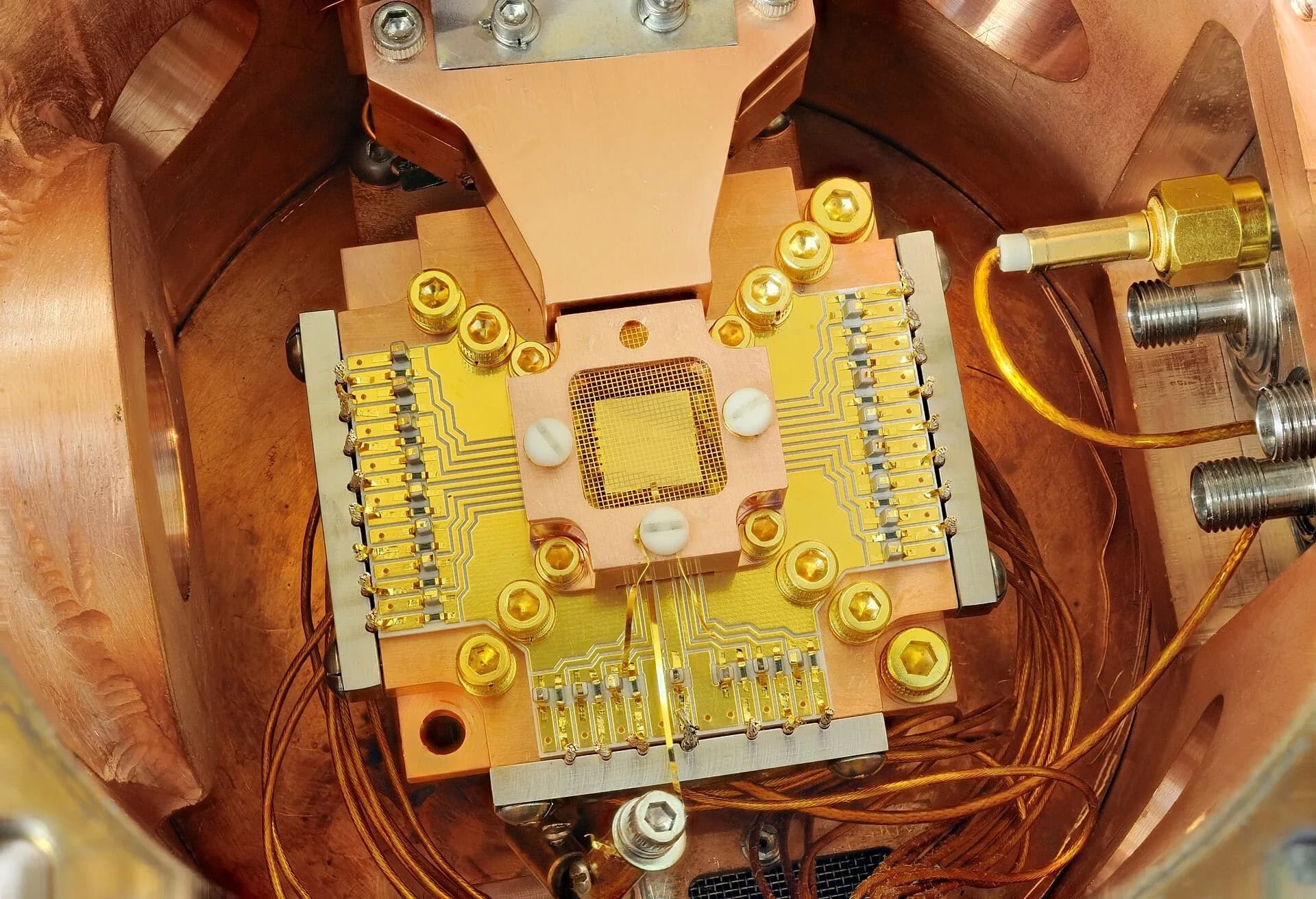
A quantum computer stores information in qubits (quantum bits). A qubit can be built from a single atom, a particle of light, or a tiny superconducting circuit cooled to temperatures colder than outer space. Unlike a bit, a qubit can be in a blend of 0 and 1 at the same time. Physicists call this superposition.
A common analogy is a spinning coin. While it spins, it is neither heads nor tails, but a mixture of both. When it lands, you see one result. Qubits behave similarly: when you measure them, you get a definite 0 or 1, with probabilities set by the blend before measurement. It is only an analogy, but it captures the key point: the in-between state carries information.

Entanglement
Qubits can also be entangled, linked so that their results are correlated in ways that have no ordinary equivalent. Measuring one qubit tells you something about the other, however far apart. Albert Einstein famously called this "spooky action at a distance". Together, superposition and entanglement let a quantum computer represent and process certain kinds of information in ways ordinary computers cannot.
Why it isn't just "faster"
This is the most important misunderstanding to clear up. A quantum computer does not try all answers at once and then pick the right one. If it did, it would be faster at everything. In reality:
- Quantum algorithms are designed so that wrong answers cancel out and right answers reinforce each other, rather like waves.
- This works only for specific kinds of problems, such as simulating molecules or breaking certain kinds of codes.
- For everyday tasks such as browsing, spreadsheets and video, quantum computers offer no advantage and would be far more expensive and fragile.
Think of a quantum computer as a specialised instrument, like a telescope, rather than a replacement for your laptop.
The hard part: errors
Qubits are extremely delicate. Heat, vibration or stray radiation can disturb them, causing errors. Useful quantum computers will need error correction: using many physical qubits to form one reliable "logical" qubit.
In December 2024, Google announced its Willow chip with 105 qubits. According to Google, as it enlarged its error-corrected arrays of qubits, from 3×3 to 5×5 to 7×7, the error rate fell by about half each time. Researchers had sought that result for decades, and it is a milestone on the road to practical machines. Google also reported a test calculation that would take a leading supercomputer an astronomically long time, but that calculation has no practical use and was designed to show the machine's capability.
What this means for you
You won't buy a quantum computer. But the technology could eventually help to design new medicines and materials, and it affects how we protect data. See our articles on quantum computers versus supercomputers and on whether quantum computers threaten encryption.
Quantum computing is real, advancing and still early. The honest summary: promising for a few important problems, far from useful for most.
Sources
This article draws on the following reporting. Dates are when each source was originally published.
- Wikipedia: Qubit
- Google Quantum AI: Meet Willow, our state-of-the-art quantum chip ·
- Wikipedia: Quantum computing

Written by
Newsroom
Reporting, explainers and analysis from The Daily’s editorial desk, based on verified public sources that are listed with every story.
More from The Daily Desk →Enjoyed this story?
Get the best of The Daily in your inbox every Sunday.